Our goal isn’t simply to show you wildlife, it’s to give you the skills to participate in monitoring it.
Ankay is developing long-term bird monitoring on Isla Solarte using standardized survey stations and repeat observations.
Participants help collect the observations that allow this dataset to grow through time.
Validated bird observations may also be contributed to eBird, part of the Cornell Lab of Ornithology’s global participatory-science ecosystem.
Accommodation in a shared dorm (or private upgrade)
Home-cooked meals Monday to Saturday
Airport pick-up
Tropical bird ecology and identification training
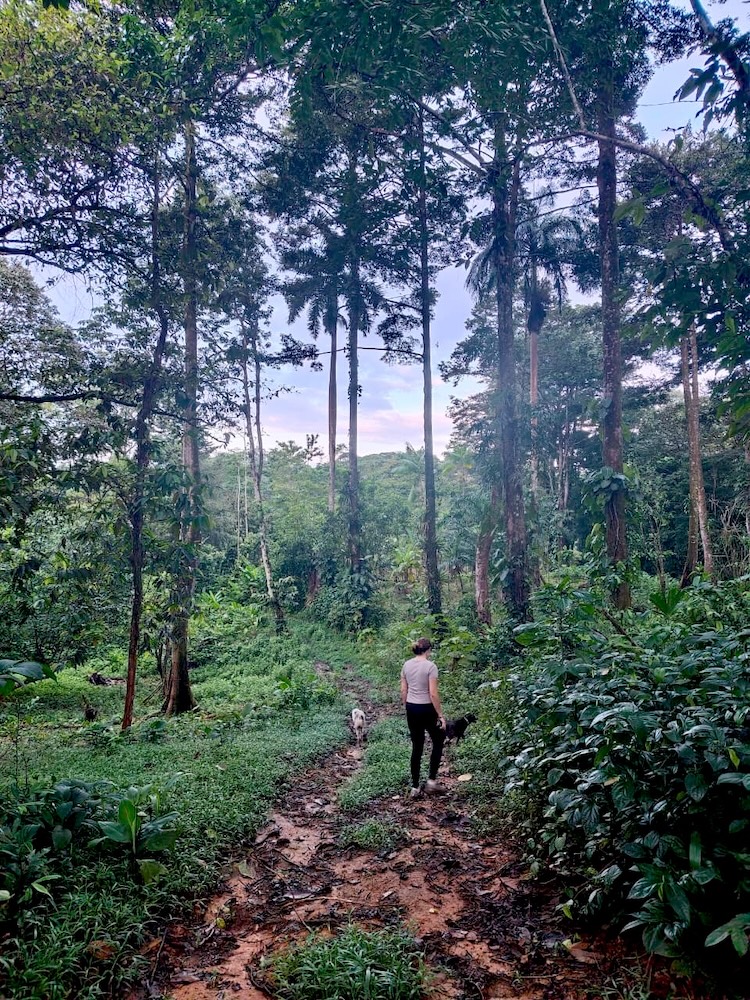
Daily jungle walk field trainings
Monitoring training and supervised conservation surveys
Program field materials
Tropical bird ecology
Visual & auditory bird identification
Merlin bird ID as an identification aid
eBird participatory science
Scientific bird monitoring with standardized methodology
Your first week focuses on building the skills necessary to understand and identify Solarte’s bird community.
Short classroom sessions are followed by field practice in the rainforest.
Topics include:
Birding sessions take place at different times of day so you can experience how tropical bird activity and detectability change from morning to afternoon.
Sunday is a free day to explore Bocas, relax at Ankay, or keep practicing independently.
Once you’ve developed your identification skills, the focus shifts toward conservation monitoring.
You’ll complete an identification review before learning Ankay’s methodology and practicing at our permanent monitoring stations.
With the supervision of the Ankay team, you’ll then contribute bird surveys.
Breakfast
Theoretical class
Approximately 45 minutes.
Field practice
Apply the day’s concepts on Solarte.
Lunch
Data entry, identification review or free time
Weather is part of field ecology. Activities may be rearranged to take advantage of the best monitoring conditions.
Ankay’s Tropical Bird Conservation Program has a duration of two weeks for $1850 USD with ITMBS included.
The daily cost is less than $135 USD per day.
We can tailor-make an experience if you have less time. Enquire if you’d like upgrades or add-ons.
Solarte’s rainforest bird community includes parrots, parakeets, hummingbirds, tanagers, antbirds, flycatchers and many other tropical species.
Some specific species seen commonly: